Saturday, January 30, 2016

CK-12 for free online learning!

Have you ever been bored while reading a dull textbook? CK-12 is here to change that, by providing an online textbook which isn't dull at all! While the website still teaches via text, it utilizes many additional interactive resources which a paperback textbook simply cannot. CK-12 is completely free of charge and does not require an account to access its bountiful content. However, if students or teachers do decide to create an account, they can access additional content which help in organizing content.


CK-12’s vast variety of content is what makes it such a spectacular online resource. From kindergarten to high school to higher education resources, CK-12 provides an interactive method of learning. This is a great resource for me to utilize because I am a visual learner. There are many people who are visual learners and CK-12 is perfect for those people because it utilizes quizzes, flashcards, simulations, videos, and many other methods to help students visualize a concept. In the spirit of CK-12 and visual learning, let’s proceed to several examples of the free online resource with some personal screenshots I took!


Currently, I am taking Calculus and we are learning about derivatives. I can easily find CK-12’s calculus section located at http://www.ck12.org/student/ . In the calculus section, there are a variety of topics. I chose Derivatives and Application of Derivatives. Instead of just providing a textbook-like explanation to me, CK-12 provides an interactive experience as well. In this section, an explanation of derivatives, an interactive visual aid, and a real world application article is provided!
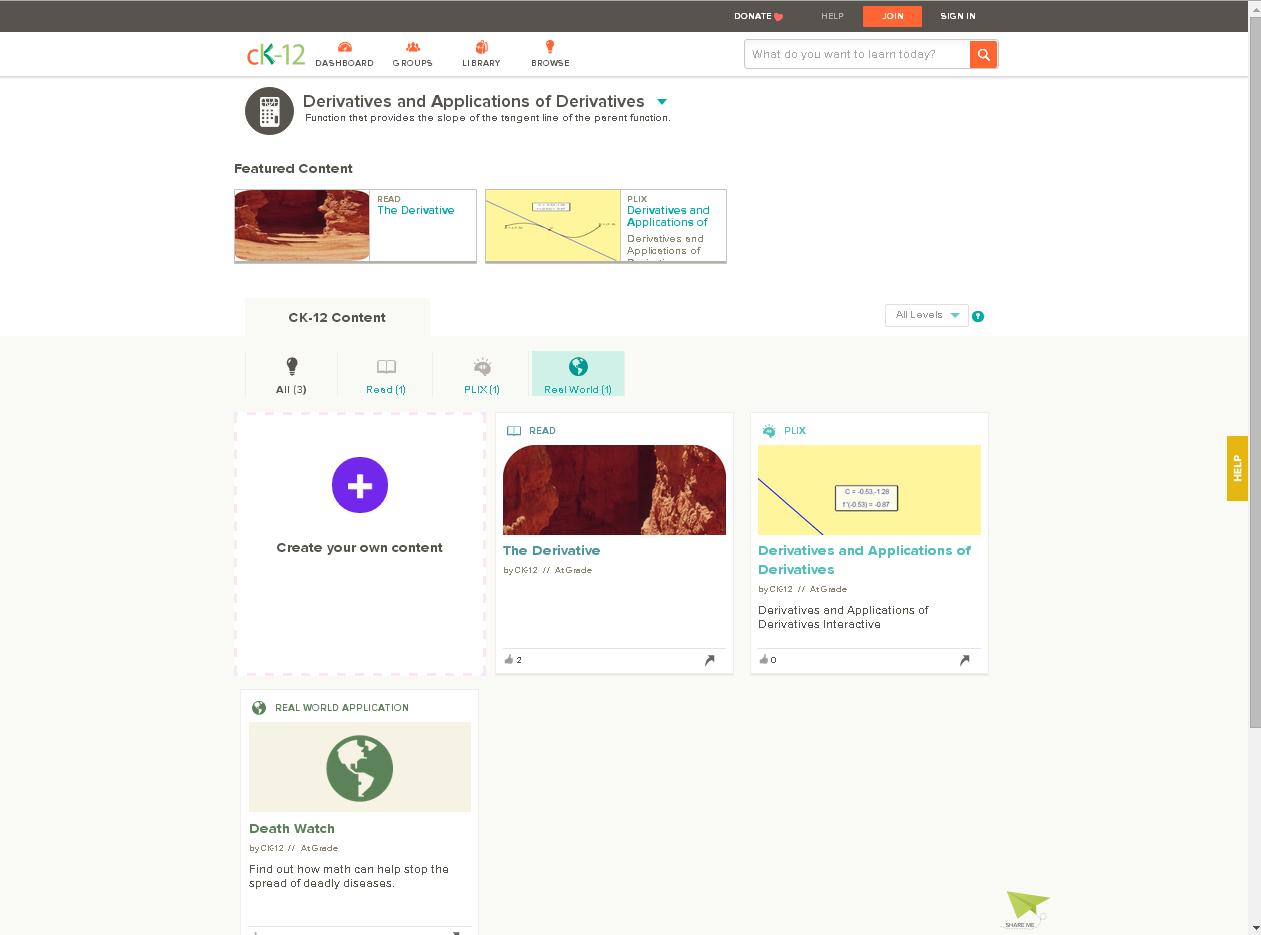


Calcmenu.jpg

Above are the options provided for this section by CK-12. Calcinteractive.jpg
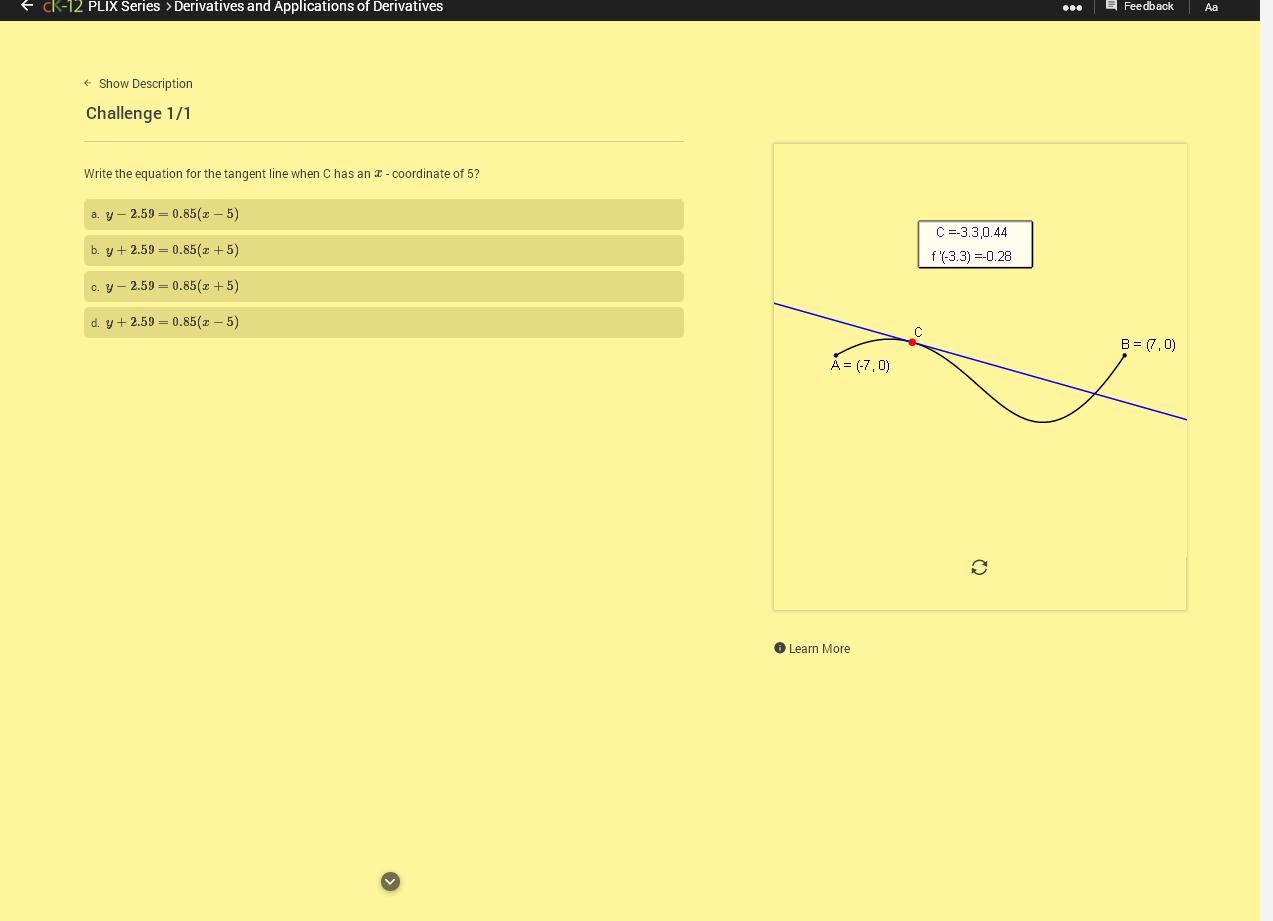
Above: The interactive visual aid of derivatives.


In addition to just content covered by core classes in school, CK-12 also provides resources for special interests. I am very interested in meteorology and I hope to be a meteorologist someday! Currently, meteorology is not provided by my school, however, CK-12 does offer some cool information.
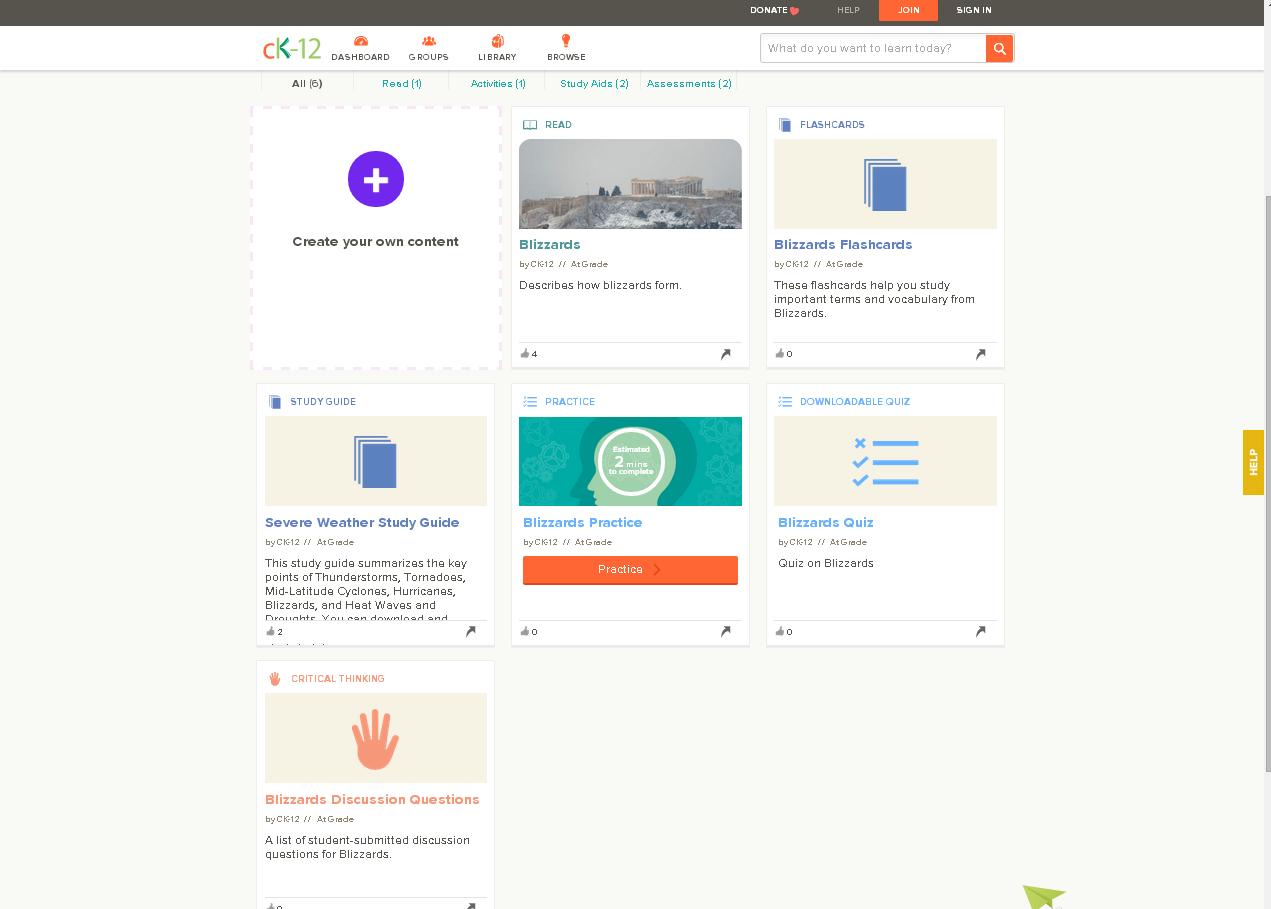
So after all the snow the Mid-Atlantic received this past week, I decided to do a little research on Blizzards. CK-12 provides even more types of resources for Blizzards! It provided me with simple reading, flashcards, a study guide, a quiz and even critical thinking! Blizzardmenu.jpg

CK-12 is a superb online resource for those who need to study for a class or just for personal interest! With its wide variety of contents,you are almost certain that you will find something interesting to learn about in a fun, exciting manner.

Enjoy!

Wednesday, January 20, 2016

Google Classroom for better Integration

In recent years, most schools have improved their technology in order to provide their students with more resources to study from. In a previous post, it was mentioned that schools began incorporating Google Nexus tablets and Chromebooks into the classrooms. Buying Android devices and Chrome OS computers are the initial steps to providing students with a better technological experience in the classroom. How can we integrate these new electronic devices better in a classroom environment? Also, if a school has 2,000 students, should every student receive a personal device? The trending Google Classroom is where schools can find perfect integration at a low cost.
Google Classroom solves many financial issues schools encounter when attempting to integrate technology into the classroom. Instead of providing a personal device for every student, schools can now encourage “bringing your own device” with the aid of Google Classroom. This is possible because Google Classroom is supported across a wide variety of platforms. From Chromebooks to iPhones to Androids, all a student needs is a web browser with internet access. Schools can now buy a limited number of devices for students who cannot afford their own.

So why should a school choose Google Classroom besides being able to keep costs low?

A school should choose Google Classroom because of its fabulous integration between teachers and students. Google Classroom utilizes key Google products such as Docs, Sheets, Slides, Drive and Calendar. Within these products, students can communicate with their peers or the teacher while working on an assignment simultaneously. The teacher also has the ability to assign work outside of class, provide critique such as the classic red pen on paper, and issue grades. All of these features are available to mobile and desktop devices. My favorite Google Classroom feature is named the push notifications on my phone, I receive a notification when a new assignment is posted. This feature really helps students like me keep track of when assignments are due.

Classroom organizes all assignments teachers post within a week into a calendar.
Above is an example of a returned assignment with teacher corrections. Another great feature of Classroom is when a student can make corrections and then  resubmit the assignment to the teacher for a new grade.


Google Classroom can be described as an organizer, a student teacher communicator or even a virtual CLASSROOM! It is cost effective and integrates very well in an academic environment. Instead of having to physically return assignments, students and teachers now have the ability to interact from their homes. Having electronic devices in a classroom is important, but the method in which they are integrated is key to educational success.

Sunday, January 10, 2016

Make learning or studying for a test fun again!

Most people that have gone through those tough stressful years of high school or college know studying for a big exam is not the most exciting thing to do. However, what if the process in doing so could be fun, or even competitive? This is where Kahoot! can present itself.  Kahoot! is a free online learning platform most commonly used by teachers and students, and is very effective within the classroom by simply using the competitive nature of humans.

So, what is the objective and how do I play Kahoot!?

The objective is to win or get on the big screen! I am sure  you're wondering, “what is the big screen?” Kahoot!, it is  typically used and  most effective in a classroom sized environment. Many people can join a single game and compete in a trivial game with others that is  created by either a teacher or another student for free. Questions appear one at a time on a big screen in front of the classroom where it is visible to all players with several multiple choice selections. While a timer counts down on the screen the users select an answer with their electronic devices. Those players who answer correctly receive points while players that give incorrect answer gain no points. However, the game is not just about answering correctly- it is also how quickly you can answer the questions. The  quicker you answer a question, the more points you receive! After each question a leaderboard with the top five scoring players appears. After all of the questions  are completed, the winner and the top five players appear on the screen in front of the room. Everyone wants bragging rights to appear on the big screen, but that is not the most important aspect of Kahoot!. Kahoot! also provides detailed statistics to the game creator regarding the questions the players were more confident in  answering as opposed to those  questions players were not. It is so specific that every single player’s performance for every single question is viewable to the game creator. This allows educators to be very specific in which topics should be covered more precisely.
So how can I use Kahoot!?

­­First of all, a teacher or a student can create a Kahoot! game by signing up for an account for free on www.getkahoot.com. In a Kahoot! game the maker of the game creates both the questions and the answers. It’s almost like a classic Jeopardy! game but much more simple. The answers are typically in multiple choice format and, once the game is created, the maker then invites users to join by providing them with a code. The game is supported by desktops via a web browser or application via the Google Play Store or Apple App Store for Android and iOS. The fact that Kahoot! is supported by so many devices and that an entire class can easily access a single game at a time encourages the positive educational usage of smartphones often found within the classroom. If the phones are going to be a temptation, why not make good use of them educationally?

So all in all, what is the benefit of Kahoot!?

The benefit of Kahoot! is to create a fun and competitive environment for students to prepare or study for exams and to aid educators regarding the progress of the students. Based on very experienced usage of this technological tool, the big screen leaderboard is very encouraging for everybody and helps students to stay engaged. Also, students can use their electronic devices in the classroom, in a fun, educational manner, rather than utilizing a of the distractions found on the internet. The students have fun when playing this game and, in turn, the answers become very genuine. With Kahoot!, teachers possess the ability to give a formative assessment without worrying about lack of effort. Not only is the data more accurate than ever, Kahoot! helps teachers tabulate results easily for each and every student.


Wednesday, December 30, 2015

“Throw away thy books!”


That’s what the Roman Emperor Marcus Aurelius (121 to 180 AD) wrote in his “Meditations” (167 AD).  His advice couldn't be more appropriate and valid today than it was back then, for one reason, which Marcus Aurelius couldn't have possibly envisioned at the time.

Going online gives you access to vast knowledge resources which didn't exist until a short time ago.  Today via online, the world is at your fingertips, or if you prefer, you can talk with Siri or Cortana, your personal digital assistant, to bring you to different sites to look for lectures, books, movies, games, what-have-you.

Yes, why not replace textbooks for learning with online access to the same materials, which, by the way, can be kept up to date much easier that way, all at greatly reduced cost, not to mention the convenience.

Actually, your entire studies can be done online nowadays instead of having to go to a physical location and sit down in a classroom, making sure being on time, having test anxieties and then having to follow the curriculum.  Online lets you work, study, have fun (learning should be fun!) from wherever you happen to be, in your home, in a park under a tree, or with friends who are interested in the same matter.

Bachelors, Masters, Doctorate Degrees can be obtained this way.  They may not have the show-off value of a Harvard, Princeton, MIT or such, institutions which have easy name and value recognition, but they should receive even higher recognition because the online learner did not get kindergarten-like attention and support to do his/her studies, but did so with self determination and dogged persistence, qualities which bode well for people who are going to accomplish things. 

All that is needed to make the online option work are three preconditions, which, by the way, will be helpful in whichever way one is going to pursue learning:  (1) Be able to read and write a language well. (2) Have the motivation and the drive to learn and strive to do whatever it takes to learn.  That’s truly the most important!  (3) Sufficient computer knowledge to make the computer do the legwork of searching, finding, reading, repeating, contacting and communicating with teachers, co-students, friends, the rest of the world, printing out when necessary, and more.  That’s all.  It’s as easy, or as hard, as that.

Paper is becoming a thing of the past, for museums to show how humans in one stage of their development used to store and handle knowledge and information.  The present and future will be almost entirely paperless, making it far easier to carry with you, paperless being easier to access and utilize from anywhere at any time at the right time for you.  Thank you, Marcus Aurelius;  Electronically available to all, via online, a fairer, fuller life ahead!

Sunday, December 20, 2015

What does the family have to do with it?


A long time ago, by the Chinese and the ancient Romans, the family was seen as the basic building block for a healthy, intelligent society.  According to Confucius (551 to 479 BC), “the strength of a nation derives from the integrity of the home.”  No doubt about it!  That’s where the education of individuals begins, and, in fact, should never end.  Today more so than ever before.

Particularly in this technology-savvy age, the home is the place where ideally all learning should begin, and flourish, very much including online learning.  The skills using one’s computer, tablet or cell phone, should be learned, imbedded and practiced from early on, just like brushing one’s teeth, for that is an essential requirement for acquiring knowledge, like feeding oneself.  In my humble opinion, the family is the best team to lead by example and help the learner along, instead of leaving it up to a biased and possibly even distorted outside environment to bring the novice into the SMS-texting plus Internet world.

There is nobody more qualified than family that can supply the love, guidance, and support to stir up “the will to win, the desire to succeed, the urge to reach your full potential ... these are the keys that will unlock the door to personal excellence,” to quote Confucius again.   And today, as well as in the future, this is true to a large extent via computers or computer-like devices.

Therefore, playing computer games is a very good thing, not a vice, because it gives your brain the opportunity for a workout and more.  Which does not mean that it can't be overdone, in case a player loses his/her relationship to time and environment, and just overdoes it,  like taking an overdose of some legitimate drug.  That’s of course sick and harmful to the person,  particularly to the person’s health,  his/her relationships and other responsibilities.  But if so, that should be easy to cure, with returning to reason and pursuing computer use with common sense.

Especially in socialist oriented societies, and very much under Soviet Communism, society developed into a non-family enterprise, where children were turned over to the state or some other outside system to grow up and become classless citizens, uniform members of the homogenous human masses.  But as we all know, and as the Soviet empire demonstrated, that model self-destructs  although modern socialists of all stripes, even in strong capitalist countries, are still trying to do the same thing the same way, hoping that the outcome will be a less competitive, less differentiated society.  That’s one reason why children often get farmed out to nursery schools as early as possible and kept in school as long as possible to learn and grow up together with their non-family peers. The peers that these children grow up with will be the ones they are working with later-on in life, playing, being friends with, maybe marry, and so on.

Well, there is a lot that gets lost by making the family just the children-production and paying-for-them-thereafter department.  The most valuable component, the personal human connection gets weakened, often substantially, or even totally lost in the process.  It converts the involved human, or humans,  into something like a machine, mostly a somewhat emotionally deprived automaton, with a greatly reduced capacity for feelings, understanding and reasoning. Eventually the human is even incapable of just pursuing thoughts or ideas for the mere fun of it.

Obviously that’s not the state we want our children or ourselves to end up in.  So the answer to the question is, yes, the family has everything to do with it.  This is why we need to have healthy, well functioning families in the first place.  That’s where true learning needs to begin, and ideally can go on lifelong.  As I learned in Asia:  “Stay home and cook rice” is to say that the real action starts in the family.  Looking anywhere else for what only your family can provide, and provide better than anyone else, is going to be a disappointing search for utopia. Although that seems to be the general practice worldwide at this stage of human development.  Therefore to end with my friend Confucius again:

"The hardest thing of all is to find a black cat in a dark room, especially if there is no cat."

Friday, December 11, 2015

Learn how, what?


Have you ever heard of or maybe even remember the popular children's books of “Dr. Seuss,” aka Theodor Seuss Geisel (1904-1991) who wrote:  “It is better to know how to learn than to know”?

Dr. Seuss made this profound statement way before the time of “How Technology Should be Used in the Classroom,” because this was long before the computer age ever began.  It clearly states what learning is all about, which is important to remember in respect to all learning, whether it was in antiquity or is now in the most advanced technological age.  It  also, applies to the entire format of how society supplies education, so far mostly through person-to-person teaching in classrooms.  But with the introduction of technology in and outside the classroom the modus is changing dramatically, in some instances.

Therefore, I think it’s high time to closely look at what really needs to be learned, and how the vast volume of knowledge we’d like to have and use, can best be acquired.  Here is the way:

What one really needs to learn and retain, in one way or the other, are three things:

(a)
Language, no matter which one in particular, but preferably one which does provide access to that vast volume of knowledge we want to acquire.  The point here is that one needs to learn one’s language well, preferably very well, which mostly can be one’s mother tongue, yet one must be able to really fully understand, speak, read and write it correctly.  In most instances this process takes place already in the family, and is person-to-person, maybe via outside teachers starting early-on in life also.  For some souls, though, they are learning language by default, by just growing up in an environment of that language, and somehow acquire some reading ability with only limited writing skills.  That’s for sure not enough, not satisfying the basic requirement of learning to be able to study and learn.  Just to function in this technology dominated world demands the thorough knowledge of language, in reading, writing, and use. 

(b)
Which brings me to the most important element required for learning:  the self-motivation to learn.  MOTIVATION needs to be there, mostly inborn in us, but not so much developed by some.  The latter are the ones who may wish to learn something, say a foreign language for example, or start attending an online course on computer science. However, they then drop out sooner or later because they really don't WANT to learn, but think that the skill or knowledge they’d like to acquire will somehow be poured into them without effort on their part.  Of course that’s not how it works.  There needs to be strong will and determination to learn on the part of the student.  Without this determination, not much is going to happen, regardless of how colorful, lively, or interesting the subject being taught might be.  Therefore, self-motivation to learn needs to be built-in, or developed, preferably already by the family, to create the right precondition for true learning to take place.

(c)
How to operate a computer, which could be a cell phone, tablet, laptop, etc.  But acquiring the knowledge and skills for working with a computer are an absolute must for enabling study and learning almost anything in the 21st century.

Once these three preconditions are met, anyone is ready to acquire knowledge with ease, regardless which method is going to be used.  We know, of course, that the old school and classroom model works.  It merely takes time and money, in many instances lots and lots of both.  Yet the same knowledge and much more is available online, and often can be absorbed and dealt with at one’s own pace and availability of time, mostly for far less money, even for free.  The blessing for us living in this century is that the world and all its knowledge is laid out before us electronically, for us to learn about, study, come back to when we want to, enjoy, and enrich our lives, all being accessible via computer and the Internet.

With Online access, why remember anything when you can look it up?  Yes, why use a large part of the Random Access Memory in your brain for storage of episodic memory instead of semantic and procedural, in other words why make your brain into a hard drive?  Using a maximum of your brain cells or RAM for playing games or doing mental acrobatics in a favorite subject is not only much easier, but also far more effective in reaching results, not to mention sheer satisfaction.  By adopting the three main requirements above, without which knowledge will be very hard work to acquire, or worse, almost impossible to make stick. Yet  access online information can open doors which were hard to open before and makes knowledge not only accessible, but also retrievable whenever needed.  Therefore my advice is to really practice and maintain (a)(b)(c) well, and you’ll acquire and use whatever knowledge there is easily, as a matter of fact as a very enjoyable and rewarding experience, Online!